Contents
1 · Overview
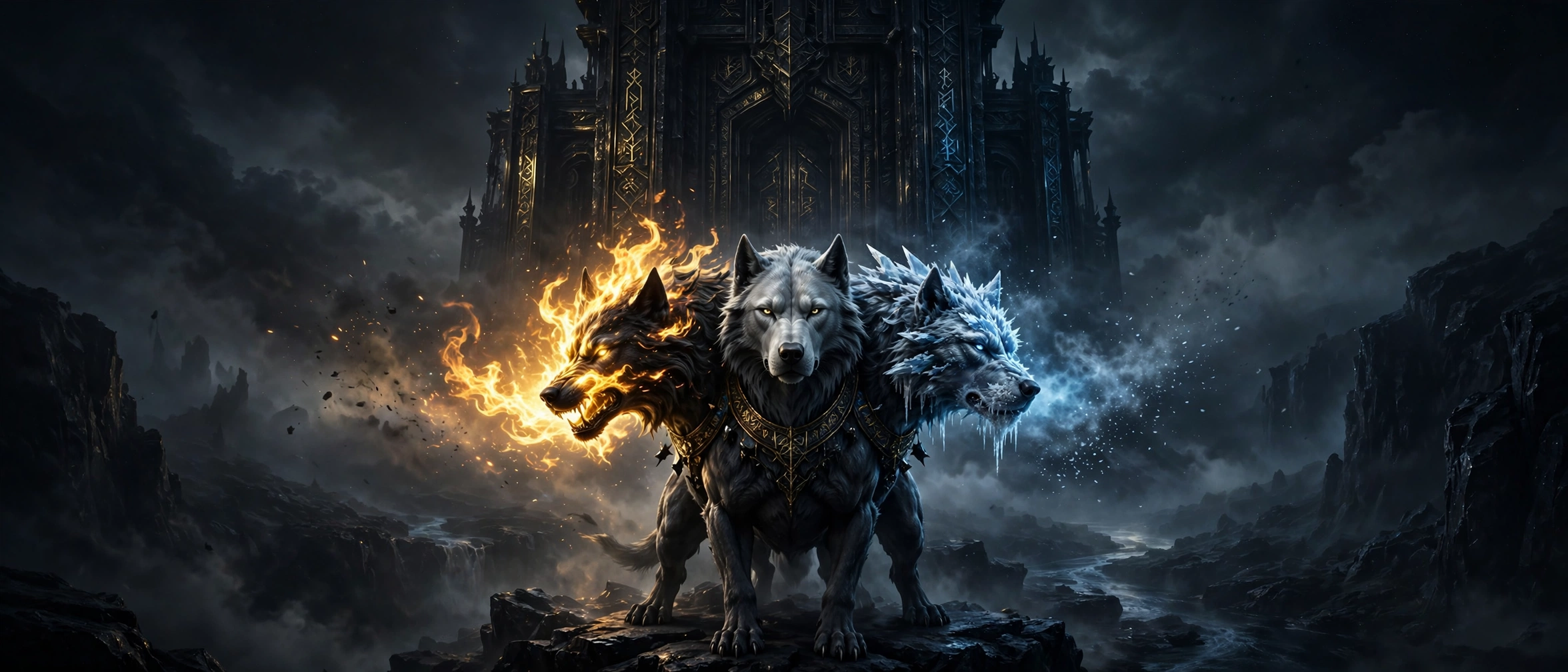
Cerberus ($CERB) is the second chapter of the GateHound universe and the first faction-PK share sale on Elysium. Two factions — the Flame Head and the Frost Head — compete for a prize pool funded by the sale itself, while a third, silver head keeps the rules: every number in this paper is enforced by the sale contract, not by promises.
Why Elysium? Elysium is a new Layer 2 built by the Kinetiq team — the team behind kHYPE — settling to HyperEVM, with HYPE as its gas token. Its mainnet opened in November 2026 with a thin application layer: launchpads exist, but there is no established playbook yet. Launching here means the rules a project ships become part of the chain's early culture — and early communities on a new chain are small, reachable and loyal in a way mature ecosystems no longer are.
HOUND, the first GateHound season on BSC, ran the same basic format — free and paid shares, two camps — and taught three expensive lessons. First: a sellout-or-nothing launch turns a slow sale into a dead sale. Second: when free and paid shares count equally, the people who fund the pool are diluted by the people who don't. Third: with no way back, rational players wait on the sidelines instead of entering early.
Cerberus is the redesign those lessons produced. The launch unlocks in tiers, starting at 300 paid shares. Paid shares weigh three-to-one in the PK split, so funding the pool is rewarded instead of diluted. And every paid buyer gets a 48-hour cooldown after the sale ends, during which they can walk away at 100% of the purchase price. The rest of this paper is the full rulebook, with the arithmetic shown.
2 · Tokenomics
Total supply is fixed at 11,300,000 $CERB, created once at deployment. There is no inflation schedule and no later mint — the only supply change after launch is the sell-tax burn, which reduces it. The full split:
| Allocation | Amount ($CERB) | Share |
|---|---|---|
| Free shares (500 × 500) | 250,000 | 2.2% |
| Paid shares (1,000 × 5,000) | 5,000,000 | 44.2% |
| Liquidity pool | 3,500,000 | 31.0% |
| Issuer reserve | 1,985,000 | 17.6% |
| HOUND holder airdrop | 565,000 | 5.0% |
| Total | 11,300,000 | 100% |
The reserve is the issuer's long-term alignment bucket — it aligns the issuer with holders across seasons rather than paying out at launch. The airdrop bucket is reserved in full for HOUND Season 1 participants (Section 8). The liquidity-pool allocation is paired with the LP leg of the raise when the pool is built at launch (Section 9).
Two allocations deserve emphasis. Paid shares are the only bucket sold for HYPE; every other bucket is either earned (free shares, the airdrop) or structural (the LP, the reserve). And because 1% of every post-launch sell is burned, the fixed supply at deployment is a ceiling rather than a constant — $CERB only gets scarcer from launch day onward.
3 · Issuance rules
The Season 1 sale runs for 72 hours. Free shares: 500 shares of 500 $CERB each, one claim per wallet, faction chosen at claim. Paid shares: 1,000 shares of 5,000 $CERB each at 0.01 HYPE per share — a maximum raise of 10 HYPE. A wallet may buy at most 20 paid shares, so a complete sellout requires at least 50 distinct paid wallets; no single buyer can corner the season.
The launch is tiered, and the tier is decided by the net paid shares that remain after the cooldown (Section 6). Below 300 net paid shares there is no launch: the sale converts to a full refund for every buyer. From 300 to 599, Tier 1 applies and the raise splits LP 65% · PK pool 20% · issuer 15%. At 600 or more, Tier 2 applies: LP 60% · PK pool 25% · issuer 15%. The Tier 2 prize increase is funded from the LP leg — never from the players' side of the split.
4 · Faction PK
Every share fights for the faction its holder chose at purchase. Weight, not headcount, decides the season: a paid share weighs 3, a free share weighs 1. When the season ends, the winning faction splits 90% of the PK pool among its members in proportion to weight; the losing faction splits a 10% consolation pool the same way. Losing costs you part of the prize, not your tokens.
The design is deliberately self-balancing. Your payout is your weight divided by your faction's total weight, so piling into the crowded side dilutes your own slice. Live weighted odds are published on the home page throughout the sale, letting the field correct itself. There is no faction cap, no hidden adjustment, and no issuer discretion anywhere in the outcome — the contract counts weight and pays by the published split.
5 · Worked examples
Three examples, computed with exactly the numbers the on-site calculator uses. Examples are arithmetic, not forecasts: they value positions at the launch price, before any market movement.
Example A — what each tier pays out
| Net paid shares | Raised (HYPE) | Tier | LP | PK pool | Issuer |
|---|---|---|---|---|---|
| 300 | 3.00 | T1 | 1.95 | 0.60 | 0.45 |
| 600 | 6.00 | T2 | 3.60 | 1.50 | 0.90 |
| 1,000 | 10.00 | T2 | 6.00 | 2.50 | 1.50 |
Below 300 net paid shares there is no row: the sale does not launch and every buyer is refunded in full instead.
Example B — PK weight
Suppose the Flame faction holds 200 paid shares and 100 free shares: its weight is 200 × 3 + 100 × 1 = 700. Frost holds 150 paid and 160 free: 150 × 3 + 160 × 1 = 610. Total field weight is 1,310, so Flame carries 53.4% of the field and Frost 46.6%. If Flame wins, its members split 90% of the PK pool pro-rata over those 700 points; Frost's members split the 10% consolation over their 610.
Example C — one player's ledger (10 shares)
A player buys 10 paid shares for 0.1000 HYPE and receives 50,000 $CERB. Under a full-sellout, Tier 2 scenario valued at the launch price: if their faction wins, the position is worth 0.1180–0.1240 HYPE — +18% to +24%, with the exact figure set by their faction's share of total weight. If their faction loses, the position is worth 0.0910 HYPE, about −9%. And if they use the cooldown instead, they receive the full 0.1000 HYPE back and lose only Gas.
6 · Cooldown refund & the refund process
The cooldown is the buyer's backstop. When the 72-hour sale window closes, a 48-hour cooldown begins. During it, any paid buyer can exit completely: the contract burns the shares and returns 100% of the purchase price — 0.01 HYPE per share — to the same wallet. The only cost is the Gas of the refund transaction itself.
How a refund works, step by step
- The sale window closes. The 48-hour cooldown clock starts automatically — no application, no approval, no queue.
- You call the refund function from the same wallet that bought the shares, at any moment inside the window.
- Your shares are burned on the spot and 0.01 HYPE per share returns to your wallet in the same transaction. Burned shares leave the supply and the PK weight table entirely.
- If exits pull net paid shares below 300, the sale flips into full-refund mode: launching is disabled permanently, and every remaining paid buyer may claim the same 100% refund. Nobody is left holding a position in a sale that never launched.
- If the cooldown ends with 300 or more net paid shares, the tier locks on the net figure, the refund window closes for good, and the launch executes on those final numbers.
Free shares involve no payment and therefore no refund — there is nothing to return. The cooldown exists for paid positions, and it is also the discipline device for the issuer: money is only kept from buyers who looked at the final numbers for two days and still wanted in.
7 · Trade taxes & the dividend pool
After launch, pool trades are taxed at source. Buys pay 1%, routed in full to the dividend pool. Sells pay 3%, split three ways: 1% is burned, permanently reducing the $CERB supply; 1% goes to the dividend pool; 1% funds issuer operations. Taxes apply to trades against the liquidity pool; they are separate from, and never taken out of, the sale raise, which is split only by the published tier rules.
The dividend pool accrues in HYPE from real trading and is distributed to $CERB holders through the staking-dividend mechanism. Like the PK pool, it is funded by activity — traders, in this case — not by new buyers' principal. A public burn counter ships with V1.5, so the deflation leg of the tax is visible on the site rather than asserted in text.
8 · HOUND holder airdrop
Five percent of supply — 565,000 $CERB — is reserved for the community that proved the format in Season 1. The snapshot is taken at the close of the HOUND sale on BSC, on 2026-11-12 at 19:10 CST, and covers every address that claimed a free share or bought a paid share. Weights: a free address counts 1, and each paid share counts 10. The issuer's and the team's own wallets are excluded. After the snapshot, claiming is self-service on Elysium using the same EVM address — no bridging of HOUND tokens is required, and nothing needs to be done before the snapshot beyond holding the HOUND position.
9 · Technical architecture
The $CERB token and the sale contract are deployed on Elysium mainnet (Chain ID 99901) — an Arbitrum Orbit Layer 2 developed by the Kinetiq team, settling to HyperEVM, with HYPE as the gas token, bridged 1:1 from HyperEVM through the official bridge. The sale contract is the single point of truth for shares, factions, weights, tiers and the refund window; the website only reads and displays what the contract states.
All proceeds are escrowed inside the sale contract for the entire sale and the entire cooldown. The issuer's withdrawal path cannot execute before the launch does — and if full-refund mode triggers, it can never execute at all, leaving refunds as the only possible movement of funds. The escrow is a property of the code, not a policy that could be revised later.
At launch, the contract builds the $CERB/HYPE pool directly on the Uniswap v4 PoolManager and takes a full-range liquidity position. That position is owned by the sale contract itself, and the contract exposes no function capable of withdrawing or moving it. Liquidity is therefore locked by structure: there is no lock-up certificate to expire and no key that can pull the pool.
Trade taxes (Section 7) are enforced inside the token contract by identifying pool trades against the PoolManager. The front-end reads sale state through a dedicated data layer; in chain mode it reads the contract directly over the public RPC rather than trusting any server, so the numbers on the site can always be checked against the chain by anyone.
The contract addresses are published on this site and on the official X at deployment, and every figure the site shows — shares sold, current tier, pool balances — can be independently reproduced from chain data with a block explorer. Trust the chain copy over any screenshot, including ours.
10 · Roadmap summary
Season 1 — this launch — is followed by Phase 2 (PK-pool yield via kHYPE staking, champion soulbound badges, the Hall of Fame), Phase 3 (HOUND × Cerberus dual-gate events and holder votes) and Phase 4 (a HyperCore graduation path and Season 2). Only Season 1 is live; the later phases are design commitments, labelled planned or in development on the roadmap page, and none of them is a shipped feature today.
11 · FAQ
Can I change my mind after buying?▾
Yes. Within 48 hours after the sale ends, exit for 100% of the purchase price: your shares are burned, the HYPE returns to the same wallet, and you lose only Gas. After the window closes, positions are final.
What happens if fewer than 300 paid shares sell?▾
There is no launch. The sale converts to full-refund mode, launching is disabled, and every paid buyer claims 100% of their purchase price back. Free shares simply lapse — they cost nothing and return nothing.
When does trading start?▾
After the cooldown ends with at least 300 net paid shares. The tier locks on the net figure, the contract builds the Uniswap v4 pool with the tier's LP leg, and trading opens from there. The exact launch transaction is announced on the official X as it happens.
How is the PK winner decided?▾
By weight, counted by the contract: paid shares count 3, free shares count 1, summed per faction. The winning faction splits 90% of the PK pool by internal weight; the losing faction splits 10%. Live weighted odds are shown on the home page during the sale.
Where do the taxes go?▾
Buys pay 1%, all of it to the dividend pool. Sells pay 3%: 1% burned, 1% to the dividend pool, 1% to issuer operations. Nothing is taken from the sale raise beyond the published tier split (LP / PK pool / issuer), and the split percentages are fixed in the contract.
How do I claim the HOUND airdrop?▾
Hold your HOUND position at the snapshot — 2026-11-12, 19:10 CST, at the close of the HOUND sale on BSC. Afterwards, connect the same EVM address on Elysium and claim self-service. Free addresses weigh 1; each paid share weighs 10; issuer and team wallets are excluded.
What is the worst case if I stay in?▾
At the launch price, a losing position is worth about 9% less than it cost (Section 5, Example C). After launch, the market price can move further in either direction — the −9% is a launch-day figure, not a floor under your position. If that downside is not acceptable, the cooldown exists precisely so you can exit at full price instead.
Why cap purchases at 20 shares per wallet?▾
So no single wallet can dominate the pool, the prize or the leaderboard. A full sellout requires at least 50 real paid wallets, and leader points stop growing at 20 shares — beyond that, standing is earned through referrals and early entry, not bought.
12 · Risks & disclaimer
Price risk. The launch price is a starting point produced by the tier arithmetic, not a floor. Once trading opens, the market price can fall — including well below the launch-price figures used in this paper's examples. The ≈ −9% losing case is a launch-day calculation only; it does not cap your loss, and a position can lose substantially more, in principle all of its market value.
Liquidity risk. Pool depth depends on the tier the sale reaches: in the worked examples, the LP leg ranges from 1.95 HYPE at Tier 1 (300 shares) to 6.00 HYPE at a full sellout. These are small pools by design. Expect meaningful price impact on larger trades, especially in the first days, and check the pool depth before sizing any trade.
Contract and chain risk. The contracts are new, and Elysium itself is a young chain that launched in November 2026 — its bridge, RPC endpoints and surrounding tooling are early and can fail or lag. The refund window, tier splits and liquidity lock are enforced in contract code and were exercised in fork testing against the live chain before deployment; testing reduces risk but cannot reduce smart-contract risk to zero.
No promise of return. Nothing in this paper, on the project website, or in any project channel is a promise or guarantee of profit, yield or price. The only commitments are the mechanical rules written into the contracts — the refund window, the tier splits, the caps, the taxes — each of them verifiable on-chain by anyone. Participate only with funds you can afford to lose entirely.